DEVLOG 01 / Start Here
What is Starforged Ascendant?
A first look at the Character, Drone, Missions, buildcraft and wider galaxy that make up Starforged Ascendant.
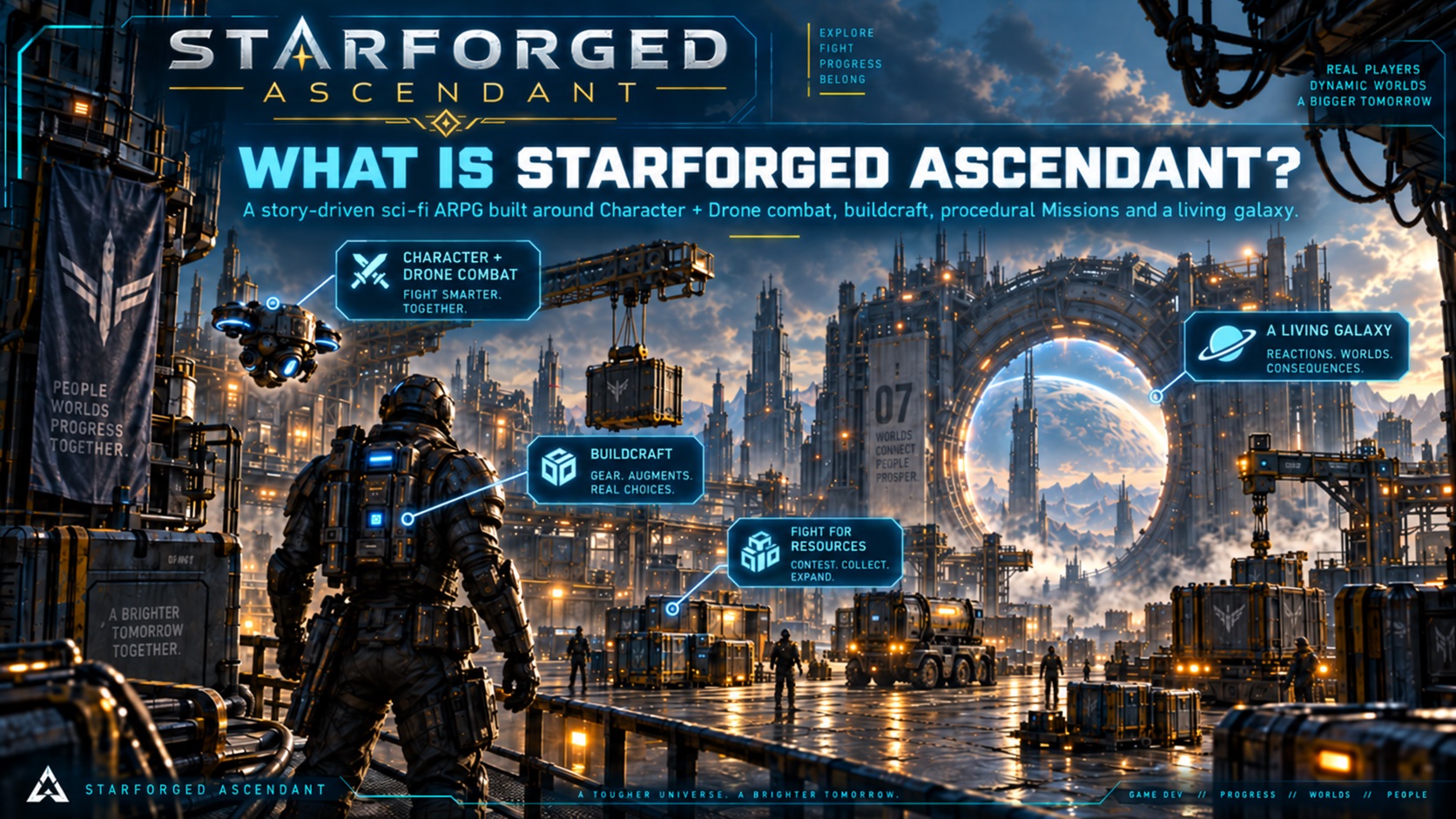
Starforged Ascendant is a story-driven sci-fi ARPG built around Character and Drone combat, deep buildcraft, procedural Missions and a galaxy intended to react to what the player does.
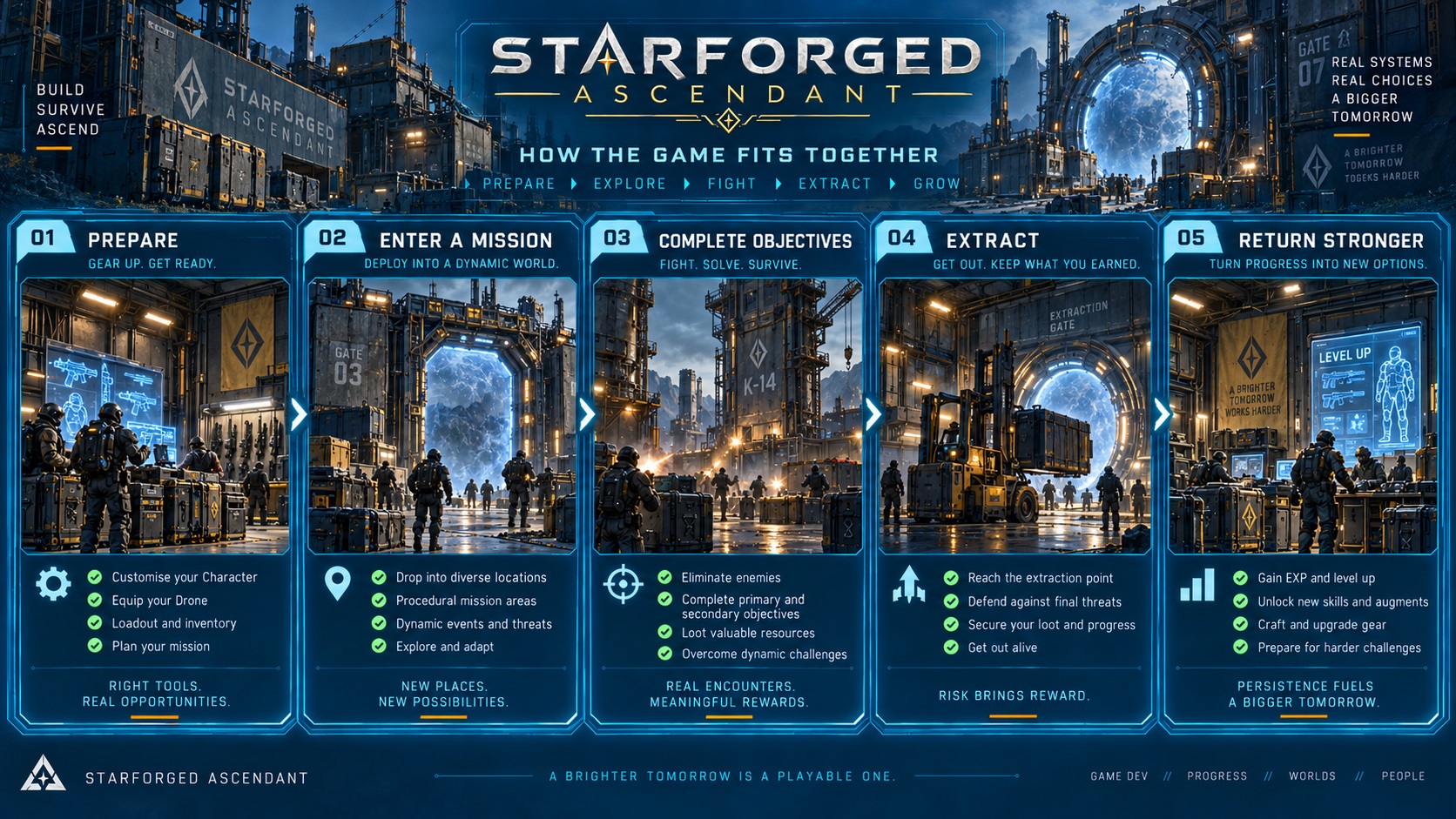
At the centre of the game is a familiar ARPG idea: prepare a character, enter a Mission, fight through enemies, complete Objectives, extract with what you have earned, and return stronger.
Starforged Ascendant builds outward from that loop.
The goal is for the equipment you find, the Skills you use, the Drone fighting beside you and the decisions you make outside combat to gradually become parts of the same larger system.
You do not fight alone
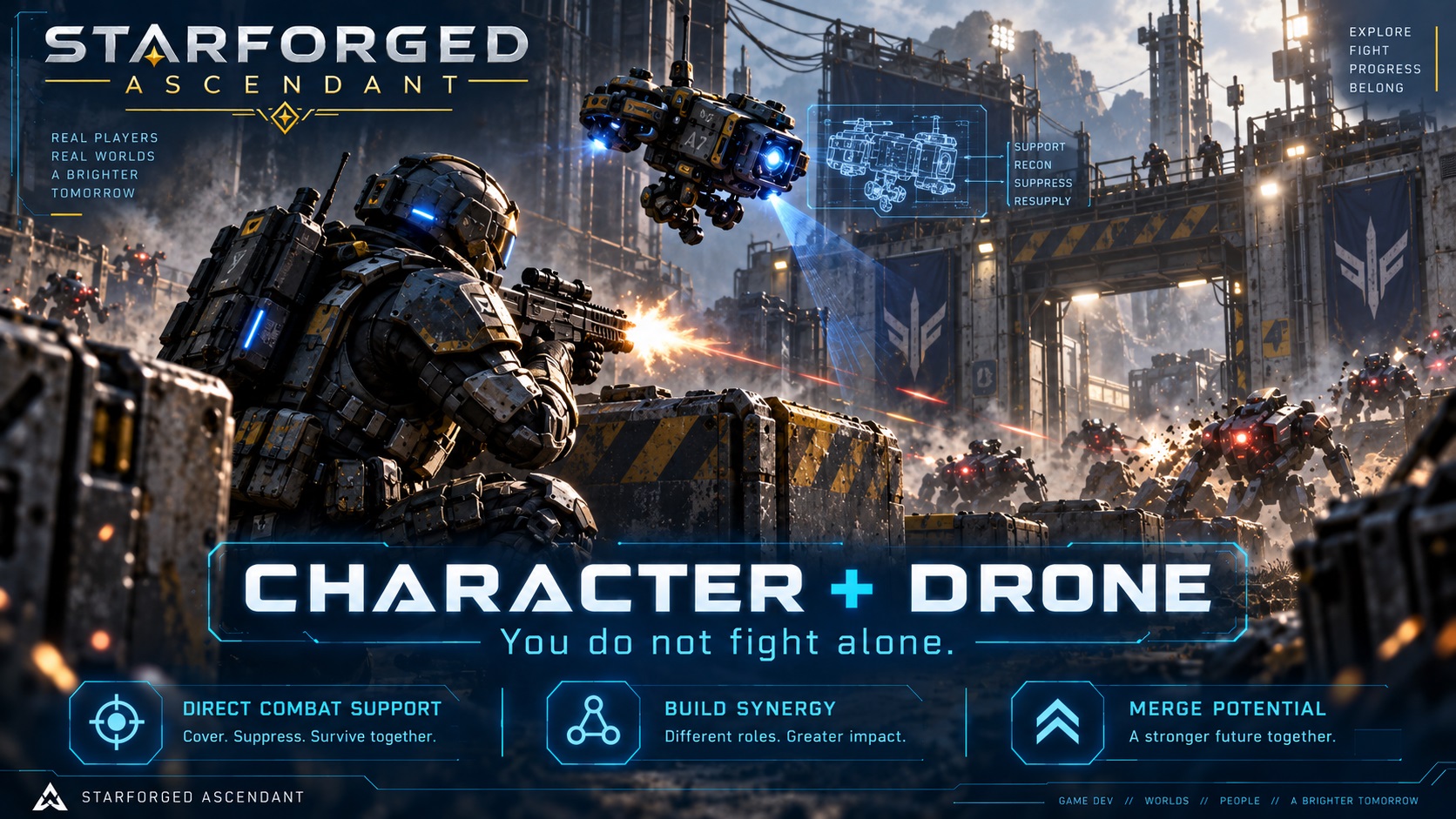
Every Character enters combat alongside a Drone.
The Drone is not intended to be a cosmetic follower. It has its own equipment, combat behaviour and Skills, and its configuration becomes another part of the player's build.
A Drone can contribute damage, control, defence, recovery or mobility depending on how it is configured. Character and Drone builds can also interact through systems such as Merge, temporarily bringing the two combat setups together.
That means building a Character is also partly about deciding what you want your Drone to contribute.
Some players may want another source of damage. Others may want battlefield control, support or a way to reinforce the weaknesses of their Character build.
Your equipment helps define how you play
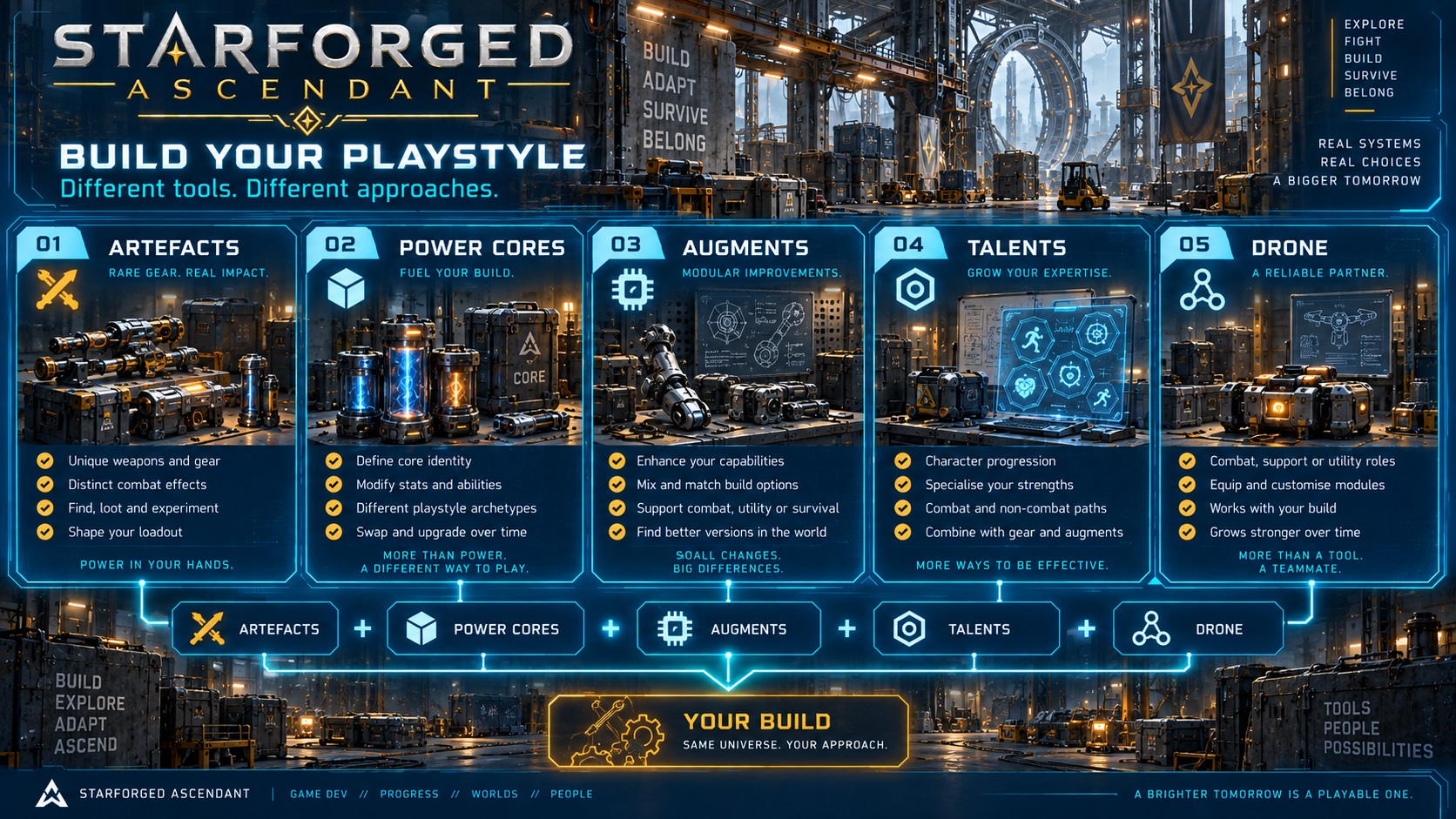
Equipment in Starforged Ascendant is called Artefacts.
Artefacts are more than containers for better numbers. They are one of the primary sources of Skills.
Changing an Artefact can therefore change both your stats and what your Character can actually do in combat.
Those Skills can then be shaped by several other systems.
Power Cores establish a Skill's Power identity and can push that Skill towards a particular style of play. The five current Power identities are Fossil, Organic, Solar, Zero Point and Fission.
- A Fossil Core can add further crowd control, helping a build contain groups of enemies.
- An Organic Core can change immediate damage or healing into damage or healing over time, trading an up-front burst for sustained pressure or recovery.
The Skill remains recognisable, but the way it contributes to the build can change substantially.
Augments provide another layer of modification by changing how a Skill is activated or what it does after activation.
- A projectile Skill might produce additional shots that bounce around the battlefield.
- An explosive Skill might instead create bouncing bombs that leave a wake of destruction.
These changes affect more than the numbers: they can alter where a Skill is aimed, how an encounter is approached and what kinds of situations the Skill handles best.
Talent Trees provide longer-term specialisation in the role a player wants to fulfil. Current Talents already show how differently those roles can develop:
- Regenerative Surge supports Tank and Healer builds. Falling below 35% Health grants 10 seconds of Resolve Immunity and restores 500 Health per second for 10 seconds, with a 60-second internal cooldown.
- Double Tap gives Pistol-focused damage builds a 20-second window in which each Pistol activation triggers an additional shot at 60% output without consuming additional Energy or charges. The Talent has a 30-second charge recovery.
- Photonic Medpulse turns every Solar Skill activation into team support, emitting a five-metre pulse around the Character that restores 300 Health and 300 Shield to the Character, their Drone and nearby allies.
These effects reflect the kinds of abilities already being built into the game. The roles are not fixed classes: they are directions a player can lean into, combine or support through their choice of Skills, Power Cores, Augments, Talents and Drone configuration.
The intention is that a finished build is not defined by any one of these systems.
It is the interaction between them.
An Artefact might give you the Skill you want. A Power Core can change the way that Skill behaves. Talents can reinforce the direction of the build. Augments provide additional control. Your Drone can then complement that setup or push it in another direction.
Later articles will break each of these systems down individually. For now, the important idea is simple: the player is building a combat setup, not selecting a fixed class rotation.
Missions are where those choices are tested
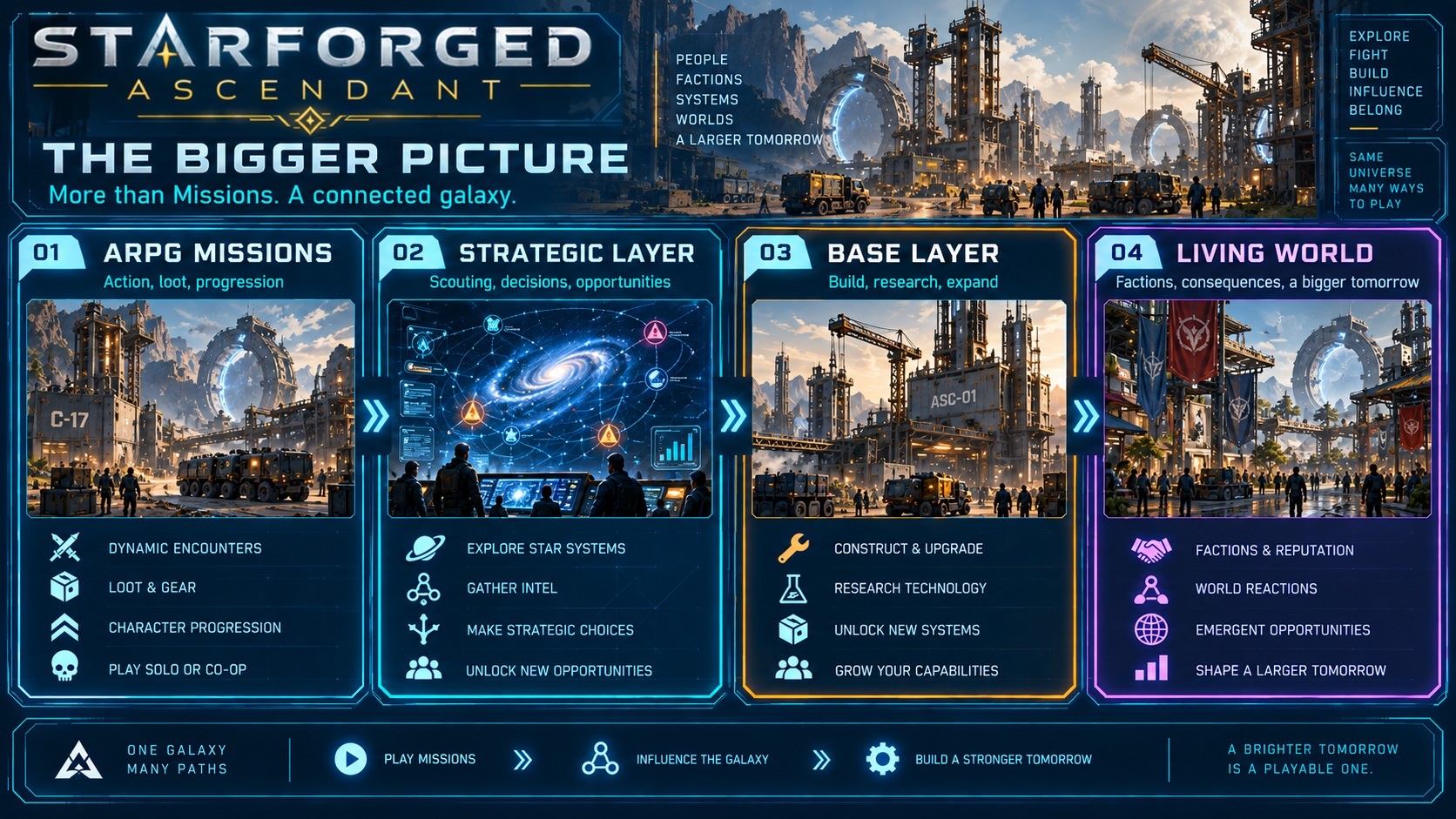
Missions are the direct ARPG layer of Starforged Ascendant.
A Mission has Objectives, enemies, rewards and a generated combat space. The current game already supports procedural room generation, enemy spawning, primary and secondary Objective tracking and extraction.
The Mission loop is designed around preparation and consequence.
You prepare your Character and Drone, enter a Mission, complete what you can, recover rewards and progression, then return to prepare for the next one.
Over time, Mission preparation is intended to become deeper as additional systems come online. Mission configuration, Power and Augment systems will allow players to influence difficulty, rewards and the conditions they are about to face.
That makes Missions more than isolated combat arenas. They are intended to become the point where character progression, build decisions and the larger state of the galaxy meet.
The game extends beyond the ARPG layer
The longer-term structure of Starforged Ascendant includes three connected layers outside direct Mission combat.
The Strategic Layer is where the player will scout, discover opportunities, work with resources, interact with Research and make decisions across the galaxy.
The Base Layer gives settlements a physical, playable form, supporting construction, production, Research and defence preparation.
The Living World is intended to govern how factions grow, weaken and respond to changing conditions over time.
These systems are not being presented as finished features today. They are the wider structure that the existing ARPG foundation is being built to support.
The important connection is that the layers are not intended to exist independently.
What happens in Missions can affect the wider game. Strategic decisions can create new Missions or change what the player is preparing for. Bases, Research and faction activity can create new opportunities, threats and reasons to return to combat.
The long-term goal is a loop where the player changes the galaxy, and the galaxy gives the player new reasons to act.
Where the project is now
Starforged Ascendant is still in development, but it has moved beyond being only a design concept.
The current development build contains a playable vertical slice with Character and Drone combat, Missions, Objectives, procedural generation, extraction, progression, inventory and significant parts of the buildcraft framework already functioning.
Other systems are being implemented, integrated, validated and expanded in stages.
Rather than presenting unfinished work as complete, this Devlog will separate three things clearly:
what is playable now, what is actively being built, and what belongs to the longer-term game.
The next article covers exactly that.
Current State — September 2026 looks at what is already working in Starforged Ascendant, what is currently being developed, and what comes next.